Overmolding for rugged drones

Drones used in industrial, agricultural, and military applications (infrastructure inspection, precision agriculture, surveillance and defense missions) operate in particularly harsh outdoor conditions. The onboard electronic systems are subjected to constant vibrations generated by the rotors, the risk of impact during hard landings, as well as direct exposure to dust, rain, salt spray, and corrosive chemicals.

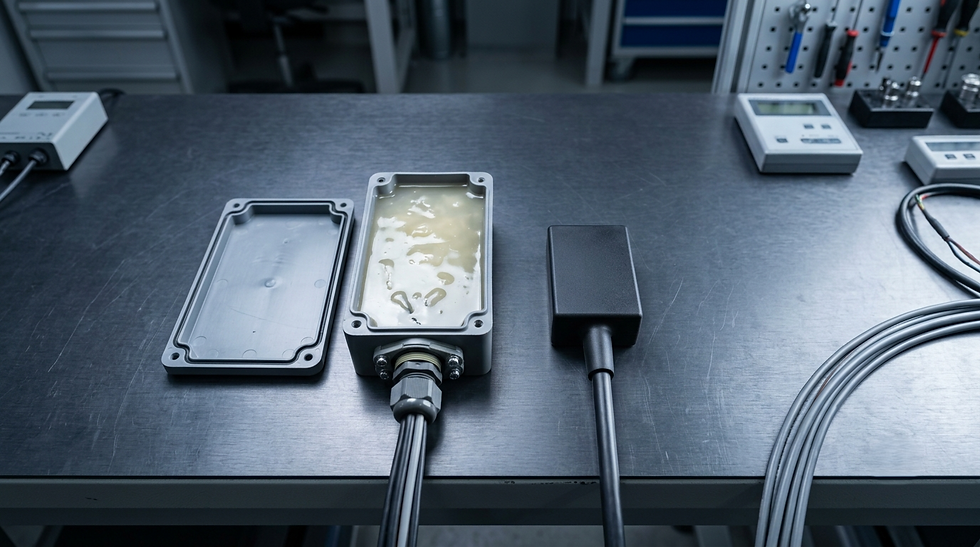
Historically, the protection of printed circuit boards (PCBs) relied on two traditional approaches with significant industrial limitations: potting and encasing. These processes require the prior fabrication of a rigid external housing in which the electronics are placed, then embedded in resin in the case of potting. In both cases, this results in added weight for the UAV, significant bulk, and long assembly times and even longer curing times that slow down production lines.
Overmolding is now emerging as the preferred solution. This process involves injecting a protective polymer directly around the circuit board at moderate pressures and temperatures, thereby eliminating the need for external enclosures. The resulting encapsulation itself becomes the protective structure for the electronics, paving the way for ultra-lightweight and extremely robust UAV designs, as well as miniaturized electronic components.
Critical advantages for industrial agricultural and military UAVs
Reduced weight and increased flight endurance
In aerospace engineering, every gram saved on the structure increases payload capacity or extends flight time. Since batteries represent the heaviest and least compressible mass fraction of a drone, optimization must focus particularly on enclosures and connectors. Overmolding reduces the packaging space for electronics by 50% or more and significantly lightens subsystems compared to traditional potting methods. This improves the stiffness-to-weight ratio and the overall specific strength of the aircraft.
Sealing Level and Ingress Protection (IP) Rating
Overmolding creates a continuous mechanical and adhesive bond between the polymer and the electronic components. The complete absence of trapped air interfaces prevents internal condensation caused by rapid altitude climb cycles. This process easily achieves IP67 and IP68 protection ratings, and up to IP69K for the most demanding aerospace applications, ensuring waterproofing in heavy rain or during flights in marine environments.
Viscoelastic Vibration Damping
Drone electric motors operate at high speeds, generating continuous harmonic vibrations that cause mechanical fatigue in the solder joints of critical components (such as BGA chips or microcontrollers). Overmolding envelops each component in a dense matrix that absorbs and dissipates these vibrational frequencies. Furthermore, in the event of a ground impact, the resin distributes the shock wave throughout the entire molded structure, reducing the likelihood of generating destructive stress concentrations.
Thermal Dissipation Without a Metal Heat Sink
Electronic speed controllers and power distribution boards generate significant heat fluxes under high operating voltages. The use of thermosetting resins filled with ceramic particles enables thermal conductivities of 5 to 10 W/m*K. These fillers create continuous thermal bridges that guide heat from the power chips to the UAV’s outer surface, making aluminum heat sinks (often twice as heavy) unnecessary.
Specific cases of electronic integration in drones
Protection of MEMS sensors and barometers
Precision barometers and differential pressure sensors, which are essential for maintaining drone altitude, cannot be embedded under a layer of polymer without blocking their air measurement ports. To solve this problem, selective overmolding must be used. Numerical flow modeling allows for the implementation of skylining geometries that create airtight barriers around the sensor while preserving a neutral air cavity above its active membrane.
Strain relief for power cabling
The cables connecting the central distribution board to the electric motors are subjected to significant tensile forces during maintenance and dynamic torsion in flight. Overmolding allows for the design of gradual geometric transitions directly on the cable sheath. This extension of flexible material prevents the concentration of bending stresses at the critical cable-to-board junction, thereby preventing mechanical fatigue failure of the conductors.
Design Recommendations
The adoption of overmolding represents a major technological leap for drone manufacturers seeking to establish themselves in the highly competitive professional UAV market.
To successfully navigate this transition and avoid common development pitfalls, the engineering team must approach each project with two fundamental considerations:
Rigorously characterize the operational environment: Determine the required level of water resistance (IP67 vs. IP69K) as early as the preliminary design phase, along with foreseeable chemical or thermal stresses, to immediately guide resin selection to meet technical criteria.
Practice PCB-to-mold co-design: Never design the circuit board in isolation from its molding tooling. Plan neutral mechanical support areas for the mold’s locating pins as early as the PCB layout stage to simplify the machining of production tooling.
References
This article is based on our expertise and a synthesis of over 30 technical sources (available upon request).


Comments