How Low-Pressure Overmolding Outperforms Epoxy Potting

Updated: Jul 9
Protecting printed circuit boards (PCBs), sensitive sensors, and connectors from environmental hazards presents a technical and logistical challenge for modern electronics manufacturers. When it comes to requirements for waterproofing, electrical insulation, and impact resistance, two methods compete on assembly lines: potting and low-pressure molding (LPM).
Historically, epoxy potting has established itself as the standard solution due to its apparent simplicity of initial implementation. However, the rapid evolution of industrial requirements—faster production rates, lighter components, simplified supply chains, and environmental imperatives—reveals the structural and economic limitations of this process. This article offers a comparative analysis of these two technologies, demonstrating how low-pressure molding is now establishing itself as the benchmark manufacturing process for optimizing electronics production.
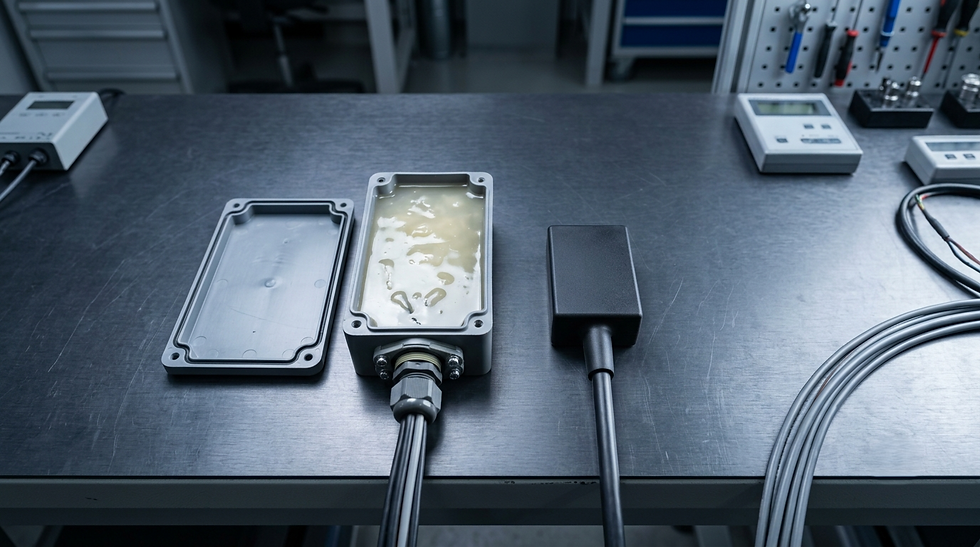
Key Differences Between Encapsulation Technologies
Epoxy potting relies on the combination of a liquid resin and a hardener. When these two components come into contact, an irreversible polymerization reaction that alters the macromolecular structure begins, forming a rigid three-dimensional network. Although this hardness provides a physically impermeable barrier, the process relies on slow chemical reactions, requiring cure times ranging from 24 to 72 hours at room temperature.
In contrast, low-pressure overmolding relies on purely physical mechanics. The material, which is solid at room temperature, is heated to its liquid phase, injected into a metal mold under minimal mechanical stress, and then cooled. Physical solidification occurs within a few tens of seconds during heat transfer with the walls of the temperature-controlled mold.
This difference in chemical and physical nature results in divergent industrial behaviors, summarized in the comparative table below:
Overall protective characteristics | Traditional potting | Low-pressure overmolding |
Transition mechanism | Chemical polymerization (thermosetting) | Physical solidification (thermoplastic) |
Number of process steps | 7 to 8 steps | 3 to 4 steps |
Typical cycle time | 24 to 72 hours | 30 seconds to 2 minutes |
BOM complexity | High (5 to 7 parts in stock) | Minimal (1 part only) |
Mechanical strength and vibration | High but rigid (susceptible to fatigue cracks) | Excellent (high flexibility and shock absorption) |
Comparison of production cycles
Analysis of value added within the production line shows that epoxy potting reduces overall productivity due to the increase in manual steps and transition downtime.
The epoxy potting production flow imposes a restrictive sequence:
Physical preparation of the circuit boards.
Manual application of masking tape to isolate connectors and threads.
Placement of the assembly into a dedicated housing or mold.
Dosing, dynamic mixing, and vacuum degassing of the reactive components.
Pouring the fluid resin into the internal cavity.
Extended curing in drying areas or energy-intensive thermal ovens.
Removal of protective masks and manual removal of flash.
Final quality control and functional testing.
In contrast, for low-pressure overmolding, the operator places the electronic assembly (or the stripped cable) directly into the aluminum cavity of the mold. The technician injects the liquid thermoplastic resin, which conforms to the contours of the components. Immediate cooling through the mold’s internal channels solidifies the thermoplastic in less than a minute. The ejected part is ready for electrical validation functional testing.
Integrity of delicate components
Preserving the physical integrity of the encapsulated electronics is one of the most critical decision criteria for design engineers. In this regard, epoxy potting presents structural risks related to its polymerization.
In fact, epoxy resins undergo significant volumetric shrinkage. This contraction generates pull-out forces that act directly on the solder joints of surface-mounted components and on wire connections, causing micro-cracks invisible to the naked eye and intermittent failures during operation.
Low-pressure overmolding proactively eliminates these undesirable phenomena. Although the thermoplastic is injected at a high temperature (180°C to 240°C), its very low viscosity allows it to flow at moderate pressures (1.5 to 40 bar), preventing any mechanical shearing of delicate components.
The polymer’s low thermal conductivity, combined with immediate cooling by the mold walls, limits the board’s thermal exposure time, eliminating any risk of internal thermal degradation. Furthermore, shrinkage during cooling is compensated in real time by the low-pressure compaction step, which injects an additional volume of material to prevent the formation of voids or residual internal stresses.
Simplification of the BOM
From an industrial financial analysis perspective, the choice between potting and overmolding should not be limited to the cost of the initial equipment, but must take into account the total unit cost.
Potting requires the recurring procurement of rigid external housings that serve as receptacles for the liquid resin. These injection-molded plastic or extruded aluminum housings increase the product’s physical volume, add weight to assemblies, and increase the number of line items on the BOM.
Low-pressure overmolding completely eliminates the need for an external housing. The injected engineering resin serves as the housing, insulator, and waterproof protection while adhering tightly to the printed circuit board. This physical integration simplifies the BOM to a single part number, thereby reducing logistics related to production inventory.
The table below shows the depreciation and costs associated with molds based on the size of production runs:
Type of molding tooling | Typical acquisition cost | Average manufacturing lead time | Useful life (Cycles) | Ideal production application |
3D-printed polymer mold (SLA) | $100 to $2,000 | 2 to 7 days | 1,000 | Rapid prototyping, small and pre-production runs |
Aluminum mold | $2,000 to $15,000 | 1 to 4 weeks | 50,000 | Medium production runs |
Steel mold | $5,000 to $25,000 | 3 to 6 weeks | 100,000+ | Transition to mass production |
Design flexibility
The geometric design freedom provided by low-pressure overmolding significantly changes the way engineers can approach the mechanical integration of electronics.
With conventional potting, the geometry is dictated by the shape of the external housing. The resin must be poured so as to fully cover the tallest component mounted on the board. This results in significant overconsumption of material in areas containing only low-profile components. This unnecessary volume adds weight to the finished device, which runs counter to the global trend toward structural weight reduction in embedded systems.
Overmolding overcomes this constraint through the use of a contoured design technique (skylining). The metal mold is machined to precisely match the asymmetrical profile of the printed circuit board, applying only a thin, uniform protective layer to the components that require it. The empty spaces between the chips are not unnecessarily filled, which significantly reduces the weight of the finished product.
The integration of secondary mechanical functions directly during the molding stage is another major competitive advantage:
Integrated strain relief: Overmolding allows the protective shell and the flexible strain relief sleeve around the outgoing cable to be molded simultaneously in a single, rapid step. Traditional potting, on the other hand, requires secondary operations for the mechanical assembly of cable glands or remote overmolding.
Integration of fasteners: Low-pressure injection-molded thermoplastic can directly form screw mounting tabs, quick-mount clips, or mechanical interlocking grooves.
Aesthetics and ergonomics: The process allows for the creation of soft-touch surfaces, the use of translucent resins for direct visual inspection of internal LEDs, or the customization of colors and company logos molded directly into the material.
Fillio, your local overmolding partner
In the current context of relocating strategic manufacturing activities and reducing global logistical dependencies, the geographic proximity of industrial partners proves to be a winning choice for high-tech companies.
Developing a new electronic enclosure or a waterproof cable harness assembly requires multiple cycles of prototyping and physical validation. Collaborating with distant or foreign suppliers introduces shipping delays, communication challenges, and high risks of intellectual property infringement.
Fillio positions itself as the strategic local partner for innovative SMEs in Quebec. By bringing together design engineering, electrical harness manufacturing, industrial 3D printing (SLA), and low-pressure overmolding under a single local entity, Fillio enables designers to rapidly iterate on their physical concepts. This technical synergy enables local tech companies to validate their design choices, produce flexible batch sizes, and maintain full strategic control over their supply chain and intellectual property.
Toward an Inevitable Technological Transition
The performance table clearly demonstrates the operational and structural superiority of low-pressure overmolding compared to traditional epoxy potting. By eliminating long drying times, the risk of physical stress caused by thermal shrinkage, and the need for bulky external enclosures, low-pressure overmolding simplifies manufacturing while reducing the total cost of ownership for electronic products.
While potting remains technically relevant for encapsulating very large power circuits requiring extreme thermal conductivity to dissipate high energy loads, low-pressure overmolding proves to be the optimal choice for protecting delicate components, precision sensors, waterproof connectors, and wired subassemblies subjected to vibrations and external stresses. Choosing to work closely with a local expert such as Fillio ensures the industrial success of this technological transition.
References
This analysis is based on our expertise and a synthesis of over 30 technical sources (available upon request).



Comments