Overmolding for Cable Assembly: Uncompromising Durability

While traditional cable assembly methods rely on a combination of mechanical components and heat-shrinkable protective sleeves, the modern industry is now moving toward integrated solutions where protection is no longer an afterthought but an intrinsic part of the assembly’s very structure. Overmolding, as a process that fuses connector technology with advanced polymerization, represents the pinnacle of this quest for reliability. This article explores the fundamentals and strategic implications of overmolding, with a particular focus on low-pressure innovations that are redefining protection standards for sensitive electronics.

Fundamentals of Overmolding
Overmolding is a complex manufacturing process that involves encapsulating an electrical junction—typically the point where a conductor meets its connector—in a permanent polymer jacket. This technique does more than simply cover components; it creates a monolithic unit that transforms a vulnerable wire assembly into a rigid, resilient component capable of withstanding extreme environmental stresses.
Pressure Dynamics: High Pressure vs. Low Pressure
The choice of injection molding process is dictated by the sensitivity of the internal components. Traditional high-pressure injection molding, which often uses pressures exceeding 100 bar, offers good surface definition and a wide variety of colors. However, these massive forces and high melt temperatures can crush delicate wires or dislodge surface-mount components (SMTs) on a printed circuit board.
Low-pressure overmolding (LPM) has emerged as the technological solution for protecting sensitive electronics. Using minimal injection pressures (typically between 5 and 10 bar), this process allows for the direct encapsulation of fragile PCBs, sensors, and connectors without compromising their original functionality. The resins used, often polyamide-based such as PA64, have low viscosity in the molten state, allowing them to fill complex cavities without exerting destructive mechanical stress on the solder joints.
Technical Parameter | High-Pressure Injection | Low-Pressure Injection |
Injection Pressure | 200 to 1500+ bar | 5 to 10 bar |
Melting temperature | 200°C to 350°C | 150°C to 210°C |
Risk to electronics | High (solder joint failure) | Negligible (active protection) |
Mold cost | High (hardened steel) | Low (3D printed or machined aluminum) |
Sealing | Excellent | Complete (IP67/IP69K) |
Design for Manufacturing (DFM): Optimizing for Reliability
The design of an overmolded assembly cannot be separated from the constraints of the injection molding process. A rigorous DFM approach helps eliminate production defects and maximize the lifespan of the final product.
Strain Relief Engineering
The cable exit point of a connector is the most vulnerable area. Without protection, repeated bending concentrates stress on the copper wires at the solder joint or crimp, inevitably leading to fatigue failure.
Overmolding allows for the design of a progressive strain relief. By adjusting the length and geometry of the overmolded section extending over the cable, engineers can distribute bending forces over a greater length of the jacket. The use of "bend ribs" in the overmolding design allows for control of the minimum bend radius, ensuring that the cable will never be bent beyond its physical limits. This approach transforms a critical failure point into a robust and durable transition zone.
Potting vs. Overmolding: A Comparative Analysis
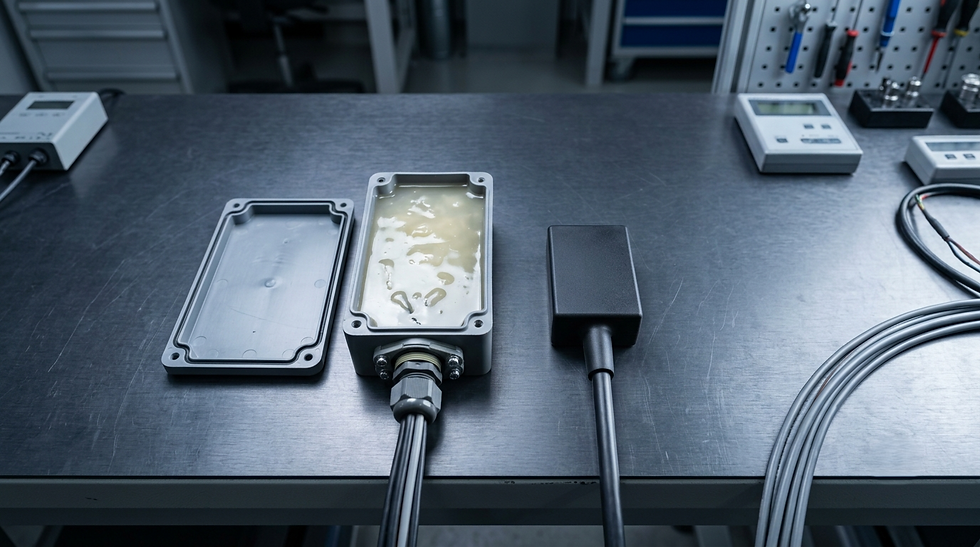
Although potting and overmolding both aim to encapsulate components, their mechanisms and results differ. Potting uses liquid resins that slowly cure within a pre-existing housing, creating a solid block. It is an effective solution for total electrical insulation and resistance to extreme vibrations.
However, overmolding outperforms potting in terms of compactness and production efficiency. By eliminating the need for an external housing and reducing air voids, overmolding enables a 30–50% reduction in volume. Furthermore, while potting often requires hours of curing time, overmolding solidifies in less than 90 seconds, enabling mass production rates that are impossible to achieve with traditional methods.
Protection Standards
The durability of an overmolded cable is not just a claim; it is validated by strict international standards that guarantee performance in real-world stress scenarios.
IP Protection Ratings
The IP rating system defines the level of protection a housing or assembly provides against solid objects and liquids. For overmolded cables, three levels dominate industry requirements:
IP67: Guarantees complete dust tightness and resistance to temporary immersion (up to 1 meter for 30 minutes). This is the standard for outdoor equipment and mobile devices.
IP68: Offers protection against prolonged immersion under pressure. The exact depth is specified by the manufacturer, generally exceeding IP67 standards. Overmolding is the most reliable method for achieving IP68, as it creates a monolithic barrier without gaskets that can age or become misaligned.
IP69K: Represents the pinnacle of protection. Originally designed for the food processing industry, this standard requires the assembly to withstand high-pressure (80–100 bar) and high-temperature (80°C) water jets. Only high-quality overmolding can withstand the thermal shock and impact force of such cleaning without water ingress.
Military Reliability: MIL-STD-810 and EMI Shielding
In the defense and aerospace sectors, sealing alone is not enough. Assemblies must meet the MIL-STD-810 standard, which simulates combat conditions: ballistic impacts, transport vibrations over rough terrain, and rapid thermal cycles.
Overmolding plays a crucial role here by integrating electromagnetic interference (EMI) management. Before injection, shielding braids or conductive foils are applied to the junction. Overmolding then encapsulates this shielding, permanently securing it in place and protecting it from oxidation, ensuring consistent signal integrity throughout the device’s lifespan.
Economic Impact and Supply Chain Optimization
Adopting overmolding is as much a strategic decision as it is a technical one. Although the initial investment in tooling may be higher, the total cost of ownership (TCO) is significantly reduced.
ROI Analysis and Total Cost of Ownership Reduction
To assess the cost-effectiveness of overmolding, one must look beyond the unit manufacturing cost. A rigorous life-cycle analysis shows that overmolding generates massive savings through:
Reduced field failures: By eliminating cable breaks at the connector, overmolding drastically reduces warranty costs and maintenance calls.
Simplified final assembly: Since the connector and protective housing are integrated, the time required for installation in the final device is reduced. There is no longer a need to manually install gaskets, compression nuts, or secondary housings.
Elimination of human error: The automation of the molding process ensures consistent quality part after part, unlike the manual assembly of heat-shrink sleeves, which depends on the operator’s precision.
Cost Factor | Conventional Assembly | Overmolded Assembly |
Initial Investment | Low (hand tools) | Moderate to high (molds) |
Labor Cost | High (multiple steps) | Low (automated process) |
Scrap rate | Variable | Very low |
Service life | Limited | Exceptional |
Product aesthetics | Utility | Professional / Branding |
The advantage of local expertise and rapid prototyping
In a context of unstable global supply chains, proximity to the manufacturer becomes a major competitive advantage. For companies based in Quebec or Canada, collaborating with a local partner like Fillio allows them to bypass international shipping delays and minimum order quantity (MOQ) constraints imposed by Asian and American giants.
The use of agile mold manufacturing technologies now makes it possible to produce functional prototypes in just a few days. This speed of iteration is crucial for innovative SMEs that need to validate their mechanical and electronic designs simultaneously before moving to mass production. The transition from prototype to small- or large-batch production is thus seamless, securing intellectual property locally.
Key Takeaway
Overmolding for cable assembly now represents the convergence of precision mechanics and polymer chemistry. By transforming vulnerable electrical connections into indestructible monolithic structures, this technology offers an uncompromising solution to the reliability requirements of critical industries.
The emergence of low-pressure overmolding has removed the technical barriers that once prevented the direct protection of sensitive electronics. Today, whether to ensure the IP69K waterproofing of a food-grade sensor, the vibration resistance of a military vehicle, or the sterility of a surgical instrument, overmolding has established itself as the go-to solution.
For engineers and product managers, choosing a local partner with expertise in these technologies—from rapid prototyping to mass production—is a major strategic advantage. By investing in durability from the design phase onward, companies not only ensure the performance of their products but also safeguard their reputation in a market where durability has become the ultimate differentiator. Durability is no longer a luxury; it is the foundation of sustainable innovation.
References
This article is based on our expertise and a synthesis of over 30 technical sources (available upon request).


Comments