Comparative analysis: Overmolding, potting, and enclosure for electronic protection
- Sacha Fabien
- Feb 26
- 8 min read

Updated: May 13
TL;DR: How to choose the best protection for your electronics?
When facing harsh environments, three solutions compete to protect your PCBs and components. Here is the core takeaway from our comparative analysis:
Low Pressure Molding (LPM): The breakthrough solution. It reduces the final volume by 30% to 50% by eliminating the air gaps found in traditional enclosures. With a production cycle under 60 seconds, it provides full IP67/69K sealing and integrated strain relief. It is the optimal choice for miniaturization and mass production.
Potting: Effective for massive dielectric insulation (high voltage), but heavy and slow. Curing cycles can take up to 24 hours, and the chemical resins used are rarely recyclable.
IP Enclosures: The classic method, ideal if you need physical access to components for maintenance. However, they are bulky, prone to condensation, and require complex assembly (screws, seals).
The Verdict: For modern electronics (IoT, transportation, medical, robotics), overmolding stands out as the best compromise between compactness, durability, and total cost of ownership.

The contemporary electronics industry is undergoing a profound transformation, where raw circuit performance alone is no longer sufficient to guarantee a product's success. Durability, resilience to extreme environments, and lifecycle cost optimization have become the new pillars of design engineering. In this context, protecting electronic assemblies—encompassing printed circuit boards (PCBs), sensors, connectors, and cable harnesses—represents a major architectural challenge. Engineers are constantly faced with the dilemma of choosing between tried-and-tested traditional methods, such as potting or the use of IP-protected packages, and emerging, more integrated technologies like low-pressure molding (LPM). This report offers a comprehensive exploration of these methodologies, analyzing their physical foundations, comparative performance, and impact on total cost of ownership.
1. The dilemma of electronic protection
The vulnerability of electronic components has increased proportionally to their miniaturization. Exposure to humidity, thermal cycling, mechanical vibration, and chemical contaminants can induce catastrophic failures, ranging from galvanic corrosion and dendritic short circuits to solder joint failure. Historically, the standard response was to isolate the electronics in a rigid enclosure. However, this approach often creates thermal "hot spots" and significantly increases the final device volume.
The modern dilemma lies in finding protection that doesn't burden the design. As electronics are now integrated into textiles (wearables), electric motors (e-mobility), and outdoor infrastructure (IoT), constraints related to weight, recyclability, and time-to-market are redefining selection criteria. Choosing a protection technology is therefore no longer a simple end-of-production step, but a strategic decision that influences thermal design, mechanical robustness, and the economic viability of the project throughout its entire lifecycle.
2. Technical Foundations of Encapsulation Methods
2.1 Low pressure molding
Low-pressure overmolding (LPM) is an injection molding process that uses thermoplastic polymers, primarily high-performance polyamides, to directly encapsulate electronic components. Its fundamental difference from traditional injection molding lies in the pressure and temperature parameters. Where standard plastic injection molding operates at pressures up to 1300 bar, LPM operates between 1.5 and 40 bar (20 to 580 psi).
This low pressure is crucial for the integrity of fragile components such as surface-mount technology (SMT) chips, gold bonding wires, or MEMS sensors, which would be crushed under conventional pressure. The materials used, such as Henkel's Technomelt resins, are thermoplastics that are solid at room temperature but liquefy when heated between 180°C and 240°C. Due to their low viscosity in the molten state, these materials flow easily around the complex geometries of PCBs, ensuring complete filling of cavities without air bubbles.
The process can be summarized in three simplified steps:
Insertion of the component (PCB or cable) into a mold, usually made of aluminum.
Low-pressure thermoplastic injection.
Rapid cooling and immediate testing of the part, the material solidifying by simple heat transfer without chemical reaction.
2.2 Potting and resin encapsulation
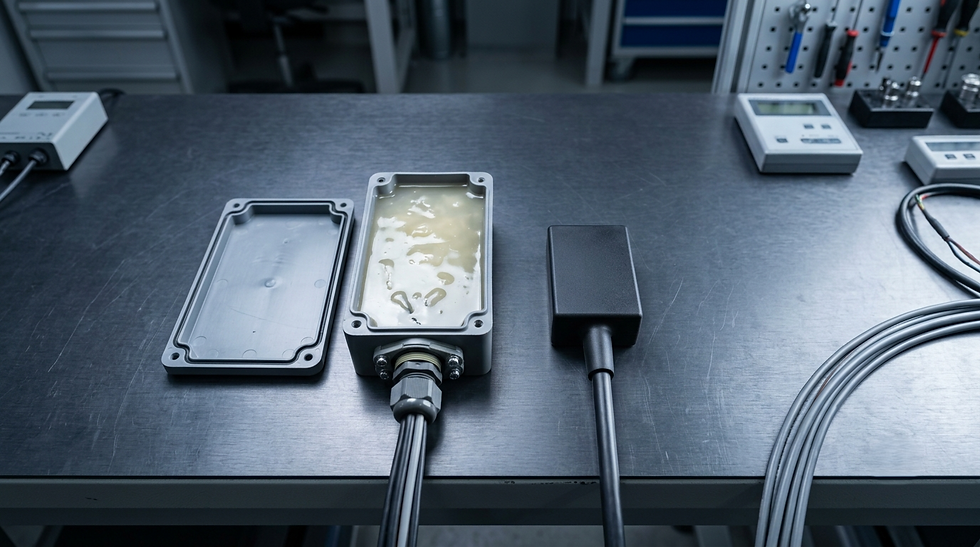
Potting involves filling a pre-formed housing or cavity with a liquid resin (epoxy, silicone, or polyurethane) that then hardens to form a solid or gelatinous protective mass. Unlike overmolding, potting is a chemical polymerization process.
This process is inherently more complex, often requiring seven to eight distinct steps:
Preparing and cleaning the case.
Dosage and mixing of components (for two-component systems).
Vacuum degassing to remove trapped air that could compromise dielectric insulation.
Cast into the casing.
Curing (hardening) at room temperature or in an oven, which can last from a few hours to several days.
One of the major risks of potting lies in the exothermic nature of the curing reaction. For some epoxy resins, the heat generated can exceed 200°C, creating an internal thermal shock that can damage welds or cause residual stresses during cooling, leading to cracking or delamination.
2.3 IP-certified enclosures
Enclosure protection relies on an external physical barrier, often supplemented by seals, to prevent the ingress of dust and liquids. The Ingress Protection (IP) rating defines the degree of resistance, with the first digit (0-6) indicating protection against solids and the second (0-9) against liquids.
Although this method seems simple, it imposes significant mechanical constraints. Sealing depends on the quality of the gaskets, the precision of the screw tightening, and the management of cable entry (cable glands). Inside the enclosure, the trapped air is prone to condensation during temperature variations, often requiring the addition of silica gel packets or selective ventilation membranes to equalize pressure without allowing moisture to enter.
Comparison Parameter | Overmolding (LPM) | Potting | IP Enclosure |
Operating pressure | 1.5 – 40 bars | Atmospheric | N / A |
Typical cycle time | 90 seconds | 24 hours | Minutes (Assembly) |
Hardening mechanism | Physical cooling | Chemical reaction | Mechanical fastening |
Main material | Polyamide / Polyolefin | Epoxy / Silicone / PU | Plastic / Metal |
Recyclability | High (Thermoplastic) | None (Thermosetting) | Partial |
External enclosure required | No | Yes | Yes |
3. Comparative analysis of performance and reliability
3.1 Waterproofing and resistance to harsh environments
The long-term reliability of an electronic device is directly correlated to the quality of the interface between the protective material and the substrate. Low-pressure overmolding excels thanks to the chemical adhesion of polyamides to common electronic materials. Tests demonstrate excellent adhesion to FR4, PVC, PA6.6, and ABS, creating a watertight bond capable of achieving IP67, IP68, and even IP69K certifications (protection against high-pressure and high-temperature washing).
Conversely, potting can suffer from local adhesion problems. The interfaces between the resin and the components (such as the copper in lead frames) constitute potential "leak paths." Under the influence of humidity and heat, delamination can occur. Research on epoxy molding compounds (EMCs) demonstrates that the presence of trapped water vapor at the interface drastically reduces fracture toughness, causing premature failures during reflow soldering or under heavy-duty operation.
3.2 Thermal management and heat dissipation
Thermal conductivity is often the Achilles' heel of encapsulation materials. Pure polymers are naturally insulating.
Where is the thermal conductivity of the material, the thickness, and the surface area? For efficient heat dissipation, these factors must either be increased or decreased.
Material | Thermal conductivity (λ) in W/m·K |
Standard silicone | 0.15 – 0.25 |
Standard epoxy | 0.2 – 0.3 |
Technomelt (Thermoplastic) | ~0.2 (Standard) |
Thermal potting resins | 0.5 – 3.0 (Loaded) |
Although potting resins can be filled with mineral particles (alumina, boron nitride) to achieve higher conductivities, they require significant layer thicknesses (typically 3 to 8 mm to ensure dielectric strength). Low-pressure overmolding offers a conceptual advantage here: the "skylining" technique. This allows for the molding of a very thin layer (less than 1 mm) over critical components, thus reducing the overall thermal resistance of the assembly despite the material's moderate intrinsic conductivity.
3.3 Mechanical behavior, vibrations and tensile unloading
In mobile applications (automotive, drones, portable tools), vibration is a major failure mode due to weld fatigue. Potting with flexible silicones is an effective solution for damping shocks, as these materials retain their flexibility from -60°C to +200°C. However, silicones offer low resistance to abrasion and direct impacts.
Low-pressure overmolding, with a Shore A hardness ranging from 70 to 95, provides robust structural protection. More than just a barrier, it allows for the integration of mechanical features such as cable glands and in-place molded strain reliefs. This eliminates the manual installation of third-party components and ensures 360-degree pull-out resistance, thus protecting the cable-PCB interface from severe mechanical stresses.
4. Strategic advantages of overmolding
4.1 Simplification of the value chain and productivity
The adoption of low-pressure overmolding radically transforms production logistics. In a traditional potting model, the manufacturer must manage a complex bill of materials (BOM): casings, lids, screws, resins (often with a limited shelf life), and cleaning solvents. Overmolding reduces this complexity to a single part number of solid thermoplastic material, stable in storage for more than two years.
The time savings are dramatic. A complete potting cycle, including mixing, pouring, and curing, often ties up parts inventory for 24 hours. Overmolding allows for the production of a finished, tested, and shipping-ready part in under 90 seconds.
4.2 Eco-design and ESG compliance
Durability has become a major differentiating factor. Epoxy potting resins are non-recyclable thermosets; once polymerized, they cannot be melted or reused, complicating end-of-life product management. Furthermore, their manufacture and handling often involve chemicals subject to regulatory oversight (isocyanates, VOCs).
Low-pressure overmolding is part of a circular economy approach. Materials like Technomelt are composed of up to 80% bio-based raw materials from renewable plant sources. As thermoplastics, they are 100% recyclable. Injection sprues and defective parts can be ground up and reinjected, thus minimizing raw material waste.
4.3 Intellectual Property Security
Physical protection against reverse engineering is a growing concern for designers of proprietary systems. A package can be opened; a potting mix can sometimes be chemically dissolved. Overmolding creates such a tight bond with the components that any attempt to mechanically remove the material inevitably results in the components being torn off or the traces on the PCB being destroyed. This constitutes an effective "anti-tamper" security barrier for critical devices such as security controllers or payment systems.
5. Case study: Impact on profitability
An analysis of a drone manufacturer showed that by switching to overmolding, it was possible to reduce its Bill of Materials (BOM) from 19 to 3 parts, and at the same time, lower the unit assembly cost from $8.20 to $2.75. This saving stems not only from reduced labor time but also from improved efficiency: automated overmolding lines achieve a 98% success rate compared to 85% for manual filling, which is prone to human error.
Characteristic | Current Molding Technology | Low Pressure Overmolding (LPM) |
Adhesive consumption / unit | 16 g / unit | 4 g / unit (PA Hotmelt) |
Adhesive cost / kg | $ X | $2X |
Adhesive cost per unit | $ Y | $ Y/2 |
Production cycle / unit | 2 hours | < 1 min |
Production space required | It occupies space for storing cases and drying | No space required for storage or drying |
The data above is taken from a real reference case.
6. Decision guide: Which method to choose?
The technological choice depends on the balance between the severity of the environment, the volume of production and the mechanical constraints.
Case 1: Priority to integration and volume (LPM recommended)
Applications : Automotive sensors, wearable electronics, IoT, medical devices.
Criteria : Need for miniaturization, high production rate (> 50k pieces/year), strict weight constraints, ecological sustainability requirements.
Case 2: Priority given to power and initial unit cost (Potting possible)
Applications : Power transformers, high-capacity batteries, downhole electronics (oil and gas).
Criteria : Need for massive heat dissipation via mineral charges, protection against ballistic shocks, very small series not justifying tooling.
Case 3: Priority given to maintenance (IP boxes recommended)
Applications : Industrial computers, onboard servers.
Criteria : Need for physical access to components for updates or repairs, environment with little exposure to intense vibrations.
7. Conclusion
The protection of electronic assemblies has evolved from a simple physical barrier to complete functional integration. Comparative analysis demonstrates that while potting and IP-rated enclosures still have specific use cases, low-pressure overmolding is emerging as the disruptive solution for modern, high-performance, compact, and durable electronics.
By radically simplifying production, reducing the total unit manufacturing cost, and meeting new environmental requirements, overmolding offers a tangible competitive advantage. The transition to this technology represents not only increased efficiency but also a genuine industrial resilience strategy in the face of the 21st-century climate and economic challenges. With this manufacturing process, Fillio enables its partners to transform fragile components into robust products, ready for the harshest environments of tomorrow.
References
This analysis is based on our expertise and a synthesis of more than 30 technical sources (available on request).


Comments